
Skylights for Schools and Educational Facilities
School buildings are often designed based on regulations, budget constraints, and standard solutions, where daylight becomes a secondary factor. Classrooms with heavy artificial lighting and windowless corridors appear.
At the same time, daylight in educational environments affects concentration and attention. Overhead natural light reduces visual strain and fatigue.
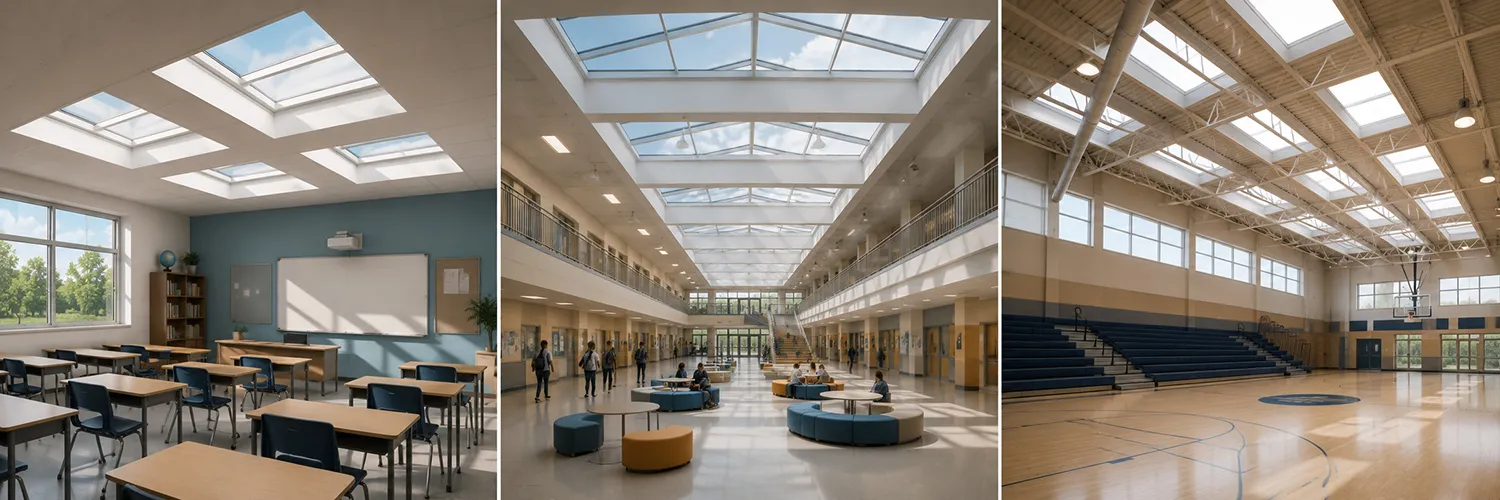
How VELUX Skylights Perform in Real Projects
Daylight throughout the Entire School Day
Commercial skylights for schools provide consistent lighting without sharp fluctuations. Light is distributed evenly, without patches or glare. Balanced lighting benefits classrooms where students work with text, screens, and boards.
Natural Ventilation
Operable models allow ventilation without drafts. Warm air naturally rises and is released through the skylights. As a result, the feeling of stuffiness is reduced and concentration improves in classrooms.
Climate Control
Modern skylights take heat exchange into account. Glazing units, blinds, and automated controls all help maintain a comfortable indoor climate.
Different Types of Skylights for Different Needs
There is no universal daylighting solution for California schools, since each zone requires an individual approach.
Fixed Skylights
Fixed models provide a steady flow of light. They are used in classrooms, libraries, and study areas where even illumination without visual distractions is important.
Venting Skylights (Fresh Air)
Operable skylights combine daylight with natural ventilation. They are often used in classrooms, cafeterias, and other high-occupancy spaces, where automated controls, rain sensors, and ventilation modes make everyday use easier.
Sun Tunnel Skylights
A solution for spaces without facade access such as corridors, restrooms, and interior zones. Light passes through a reflective tunnel and enters the room through a ceiling diffuser. This solution is especially effective for spaces without facade lighting.
Modular Systems
For large spaces such as atriums, gymnasiums, and common areas. Skylights work as part of the architectural composition and shape the perception of scale and volume.
Light Control
School spaces are used in different ways throughout the day. A classroom may need full daylight for lessons and darker conditions for presentations only hours later.
VELUX integrated blinds, available with different blackout levels, and electric or solar-powered controls make these adjustments quick and simple.
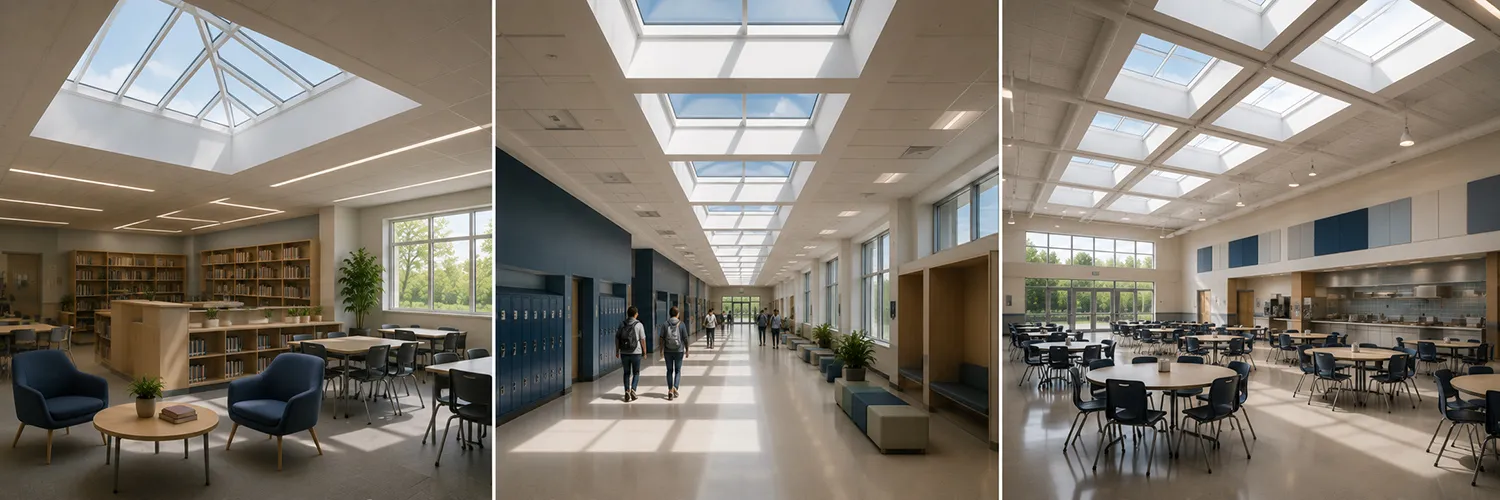
How to Place Skylights in Educational Buildings
Consider building orientation. The north side provides softer and more stable lighting, while the south side requires overheating control, especially in spaces with large glazed surfaces.
The size and number of skylights directly affect light distribution and the perceived depth of the space. In most cases, several light points perform better than one large surface.
It is also important to establish a lighting rhythm within the space. Commercial skylights for schools can be arranged in linear layouts or grouped to create even light distribution.
Where Skylights Perform Best
- The effect of skylights varies depending on the function of the space.
- Classrooms: even light and visual comfort.
- Corridors: a greater sense of openness.
- Libraries: soft, comfortable lighting for reading.
- Cafeterias: a brighter, more lively atmosphere.
- Gymnasiums: natural light without glare.
- Common areas: a stronger sense of openness and spaciousness.