
Energy-Efficient Skylights for Commercial Buildings
In commercial architecture, there are solutions that affect operating costs and the performance of the entire building. Commercial daylighting systems are one of them.
Daylight changes throughout the day and reduces the load on artificial lighting. In offices and commercial spaces, this affects work, concentration, and the perception of space.
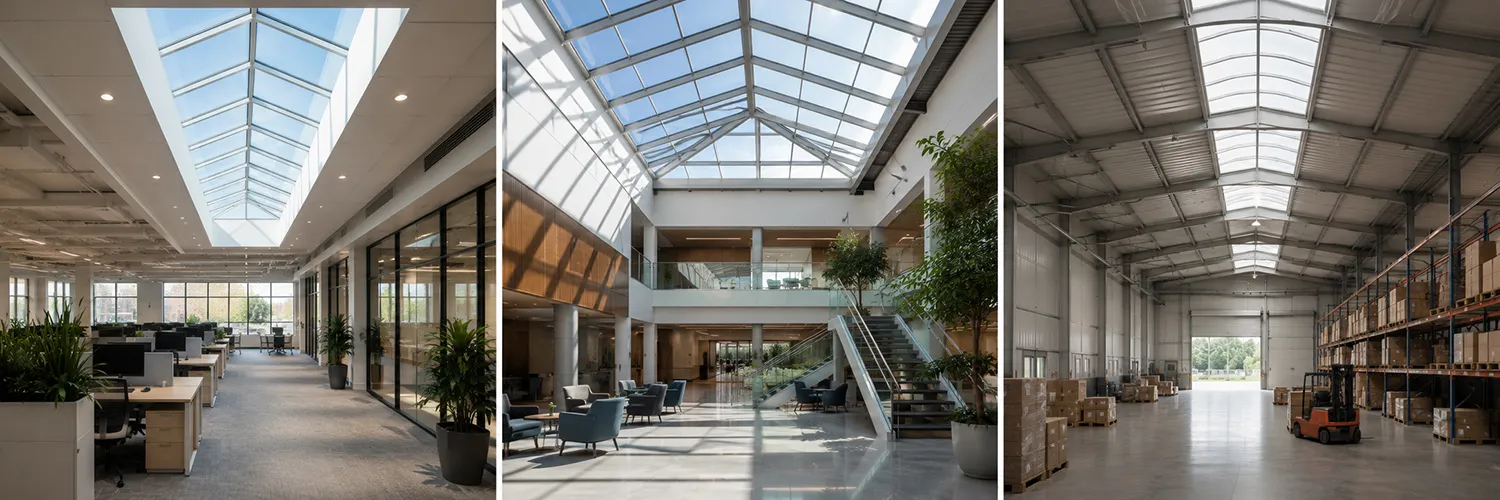
What Affects the Energy-Efficiency of Skylights
Behind the apparent simplicity, there is an engineering approach. A skylight is a system that manages daylight, heat gain, and glare in a controlled way.
High quality glazing allows sufficient light to pass through without overheating the space. The key factors are heat loss and the amount of solar heat entering the building, which are measured by U value and SHGC. They determine how efficiently the structure retains heat inside the building and regulates solar energy gain.
Lighting comfort is just as important. Light in sustainable commercial buildings should be comfortable, without harsh contrasts or glare, which is why skylights use light diffusing glass and matte finishes that provide even distribution of daylight throughout the space.
These principles are implemented differently in commercial architecture. It all depends on the scale, the function of the building, and the architectural objective.
Modular Skylights: A Structured Installation System
Modular skylights are delivered as ready-made, pre-engineered and tested elements. Only installation is carried out on site, which significantly reduces construction time and lowers the risk of installation errors.
The system already integrates the coordinated operation of key functions. Light, ventilation, and overheating protection work as a single system with the option of automated control. This is especially important for eco-friendly commercial buildings with variable load throughout the day, such as offices, schools, and public spaces.
Metal Framed Skylights: Flexible Solutions for Commercial Architecture
Metal framed skylights are used in projects where adaptation to the architecture and large glazing areas is required.
The metal frame allows for different shapes and sizes of openings, as well as the integration of ventilation and light control systems into a single structure. These solutions are used in office and public buildings where stable natural lighting and operational reliability are essential.
Glass and Custom Skylights: Tailored Solutions for Complex Projects
In some projects, standard solutions are not possible. This includes atriums, complex roof structures, and large public spaces. In these cases, glazing provides large transparent surfaces that maximize access to daylight.
The glass must also withstand operational loads, maintain thermal performance, and control solar heat gain. Each solution is developed strictly according to the specific architectural and engineering parameters of the project.
As a result, glazing characteristics are defined through individual calculation.
Unit Skylights: Practical Solutions for Commercial Buildings
In sustainable commercial architecture, along with complex systems, more standard solutions are also used, designed for typical tasks and large areas.
These include dome and flat skylights used in industrial buildings, warehouses, and retail facilities. They provide a stable level of natural lighting and can be easily scaled to the size of the project.
Their main advantages are predictable performance, ease of installation, and cost efficiency when used over large areas.
Solutions for Spaces without Natural Light
Some parts of a school, such as internal corridors, utility rooms, and other windowless spaces, receive little or no natural light. VELUX Sun Tunnel skylights bring daylight into these areas through a highly reflective tube that channels light from the roof.
They are ideal for spaces where a conventional skylight cannot be installed, bringing daylight to areas that would otherwise rely on artificial lighting.